
Honoring Black Workers Who Built the Labor Movement — and the Power of Organizing in the South Today
This Black History Month, the RWDSU honors the Black workers, organizers, and leaders whose courage and collective action built the American labor movement – and whose legacy is the foundation of our ongoing fight to organize the South.
From warehouses to healthcare to poultry plants, Black workers in the South have always been the heartbeat of the struggle for economic justice in our union and beyond. They organized not only against exploitative employers but against a system designed to deny them power altogether.
Henry Jenkins: RWDSU’s Trailblazer
Henry Jenkins, RWDSU VP on Organizing in the South.
Henry Jenkins was a prominent labor leader and civil rights activist who served as a Vice President of the RWDSU and as President of the RWDSU Alabama and Mid-South Council. A black union organizer in the Deep South, Jenkins played a critical role in bridging the gap between labor rights and the Civil Rights Movement. Notably, during the 1965 Selma to Montgomery marches, Jenkins and fellow RWDSU members provided essential support by bringing supplies, food, and tents to the marchers’ campsites. His activism often put him in significant danger; in 1964, he survived an attack where a rifle bullet was fired through his car windshield while he ate lunch. Jenkins remained a steadfast advocate for workers' rights and racial justice until his passing in 2011, leaving a legacy that continues to influence the RWDSU’s worker-led, social justice organizing models in the South today.
Henry Jenkins and the RWDSU played an indispensable role during the 1965 Selma to Montgomery marches by transforming their union infrastructure into a lifeline for the civil rights movement. As the marchers prepared for the grueling 54-mile journey, the RWDSU’s resources provided the behind-the-scenes logistics that made the mass demonstration sustainable. The union supplied large industrial tents, mobile kitchens, and steady streams of food and water to the campsites where activists rested between legs of the march. This support was more than just charitable; it was a deliberate act of labor-civil rights solidarity in the face of violent opposition from state authorities and the KKK. By mobilizing union members to act as marshals and supply-runners, Jenkins and the RWDSU demonstrated that economic justice and voting rights were inseparable, cementing the union's legacy as a cornerstone of the movement in Alabama.
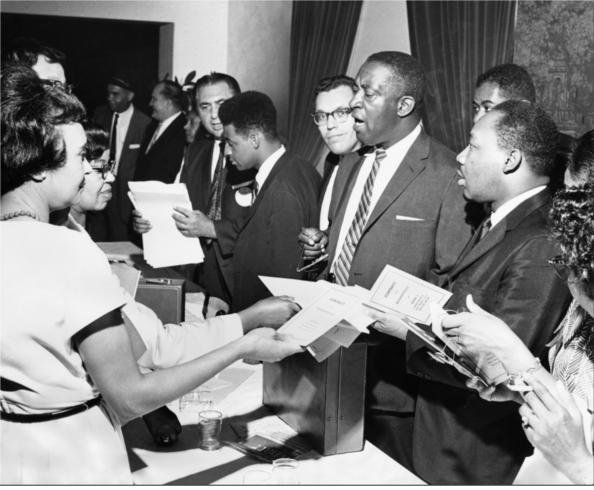
Dr. Martin Luther King, Jr., (right) reviews an RWDSU contract with RWDSU Local 3 members employed at Bloomingdale's in New York City in the 1960s.
The Giants Who Paved the Way
A. Philip Randolph: Power Where It Was Denied
A. Philip Randolph proved that Black workers could win even in the most hostile environments. By leading the Brotherhood of Sleeping Car Porters starting in 1925, he demonstrated that labor rights and civil rights are inseparable. This lesson remains vital today in the South, where anti-union laws and historic inequities are still used to suppress worker power. Randolph’s persistence showed that organized labor is the most effective vehicle for achieving Black economic self-determination.
Bayard Rustin: The Architect of Strategic Solidarity
Bayard Rustin was a master strategist who understood that social change is impossible without economic change. Beginning his activism in the 1940s, he famously went on to organize the 1963 March on Washington for Jobs and Freedom. Rustin argued that real power comes from sophisticated coalitions between unions and civil rights groups. His vision remains a blueprint for modern organizing, emphasizing that strategic unity is the only way to dismantle entrenched corporate opposition.
Addie Wyatt: The Intersection of Labor and Equality
Addie Wyatt shattered the glass ceiling by proving that a worker’s struggle cannot be separated from their identity as a woman or a person of color. Rising to leadership in the United Packinghouse Workers in the early 1950s, she championed “equal pay for equal work” decades before it became a national slogan. Wyatt’s legacy teaches us that justice requires an intersectional approach – one that addresses the specific barriers faced by Black women on the front lines of industry.
Dr. Martin Luther King Jr.: Unions as a Tool for Freedom
Dr. King called unions the most effective “anti-poverty program” in history. From the mid-1950s through his final campaign in Memphis in 1968, he underscored a reality still felt today: Black workers are often asked to do the hardest jobs for the least pay. For King, organizing was about more than a paycheck – it was about dignity, safety, and the right to be heard. He believed that the labor movement was the strongest ally in the fight for true social justice.
Why Organizing the South Matters Now
The South is the front line of the modern labor movement. It is home to a disproportionate share of low-wage jobs and over 56% of the U.S. Black population. The Stakes for Black Workers:
The Union Premium: Nationally, Black union members earn roughly 14–16% more in wages than their non-union counterparts.
Closing the Gap: In the South, where the racial wage gap is widest, a union contract is the single most effective tool for ensuring equal pay for equal work.
The “Right-to-Work” Trap: These laws, which prevail across the South, have deep roots in Jim Crow-era efforts to prevent interracial labor solidarity.
Despite these hurdles, workers are rising. From poultry plants, warehouses, manufacturing facilities, food processing plants and more from the Carolinas across Georgia, Alabama, Louisiana, Florida, Mississippi, Tennessee and more Black workers with the RWDSU are demanding safer workplaces, fair scheduling, and living wages – and RWDSU is proud to stand with them.
RWDSU in the South: Carrying the Legacy Forward
RWDSU’s work reflects the long tradition of Black-led organizing. Whether it is manufacturing, food processing, or distribution, our members are organizing in communities where union power has historically been denied – and where it is needed most.
In Alabama and across the region, RWDSU members are standing up to the largest corporations in the world, including Amazon. These campaigns are about more than any single workplace; they are about challenging an economic system that has relied on exploiting Black labor for generations.
Across our Southern shops, Black workers serve as:
Elected Officers leading our union.
Lead Organizers building our ranks.
Shop Stewards protecting our contracts.
Bargaining Committee Members negotiating for the future.
Black History Is Labor History
The story of labor in the South cannot be told without Black workers. Every gain, from workplace safety to fair pay, has been hard-fought against systems designed to keep power at the top. Organizing Black workers in the South is not a strategy, it is a moral imperative. When Black workers win, the floor is raised for every worker in the country.
Their Legacy – Our Responsibility
The legacy of Randolph, King, Wyatt, and Rustin lives on every time a worker decides they deserve better and organizes with their coworkers to demand it. This Black History Month, we honor the past by continuing the work: organizing the South, building worker power, and fighting for justice on the job.
Are you ready to build power in your workplace?